Britain Has an AI Problem
Cheaper expertise could be a considerable national advantage. It may prove less agreeable to those who expected to spend a lifetime selling it.
In Britain, a “good job” is a social arrangement as much as an occupation. It promises that educational effort will produce a reasonably dependable income, some autonomy and a respectable answer when someone at a wedding asks what you do. The work may be exhausting or faintly pointless. Its chief attraction is that technological upheaval is supposed to happen to somebody else.
Artificial intelligence is making that assumption harder to sustain. The difficulty for Britain is that much of its professional economy involves precisely the activities generative AI is becoming useful at: interpreting information, preparing documents and producing analysis. The country has invested heavily in teaching people to do such things. Those people have made rather larger commitments on the assumption that doing them would remain expensive.
The scale is substantial. According to the Office for National Statistics’ Annual Population Survey, managers, professionals and associate professionals accounted for 54% of employment in Great Britain in the year to June 2026. These broad categories include nurses and engineers as well as consultants. They are neither a census of the middle class nor an inventory of replaceable workers. They do, however, show how thoroughly professional employment has become an ordinary British expectation.
It is also a national specialism. In 2025, Britain exported £98.7bn of financial services and £179.2bn of “other business services”, the broad category encompassing much professional and technical work, according to the government’s trade statistics. Britain earns considerable sums helping others organise their affairs. A change in the economics of that assistance would extend well beyond a few uncomfortable graduate recruitment rounds.
The educational hierarchy offers surprisingly little guidance about exposure. The Department for Education’s analysis of AI and employment placed professional occupations, including finance, law and business management, among the most exposed. Higher qualifications were associated with greater exposure; London and the South East stood out geographically. These were estimates of the tasks technology could affect, rather than forecasts of redundancies. Even so, they complicate the familiar advice to escape technological competition by acquiring more education.
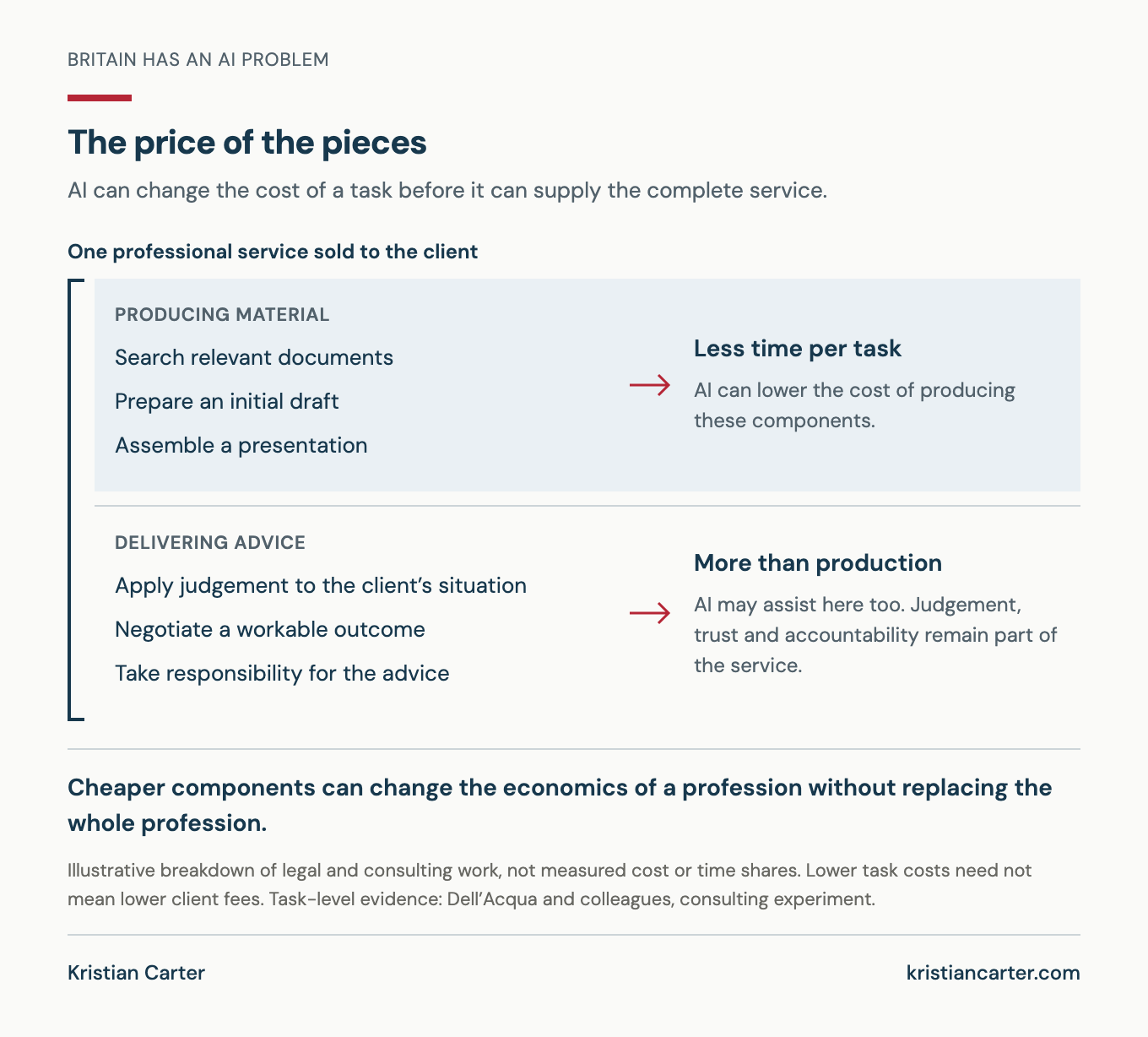
The reason becomes clearer when professional work is taken apart. A solicitor supplies legal knowledge, but also judgement, negotiation and responsibility for getting things right. Within that service sit activities such as searching documents and preparing an initial draft. A consultant may understand an organisation exceptionally well while spending much of Tuesday arranging information into slides. The profession sells the whole package. AI can change the cost of individual components long before it can supply the package itself.
The price of the pieces
AI can change the cost of a task before it can supply the complete service.
One professional service sold to the client
Producing material
- Search relevant documents
- Prepare an initial draft
- Assemble a presentation
AI can lower the cost of producing these components.
Delivering advice
- Apply judgement to the client’s situation
- Negotiate a workable outcome
- Take responsibility for the advice
AI may assist here too. Judgement, trust and accountability remain part of the service.
Cheaper components can change the economics of a profession without replacing the whole profession.
That change is already visible in experiments. A study involving 758 Boston Consulting Group consultants found that, on a set of tasks suited to GPT-4, participants using it completed more work and finished roughly a quarter faster. On a task outside the model’s capabilities, however, AI users were 19 percentage points less likely to reach the correct answer. Professional judgement plainly retained a function. Unfortunately for anyone charging by the hour, the time required to produce useful work was also becoming negotiable.
There is a large distance between such results and the disappearance of professional employment. In research linking chatbot adoption to Danish employment records, Anders Humlum and Emilie Vestergaard found no significant effects on earnings or recorded hours in the occupations studied during the early adoption period. Organisations can absorb a faster task without changing their staffing. Anyone familiar with office life will recognise its capacity to accommodate a modest efficiency gain without noticeably shortening the working day.
The economic question is therefore how much professional labour will be required, at what price, as firms reorganise. If cheaper advice attracts enough additional customers, employment could expand. A small business that previously avoided legal or financial advice might begin buying it. A developer who can deliver software more cheaply may find more projects worth undertaking. Britain could become better at exporting services it already sells successfully.
But greater productivity does not determine who receives the proceeds. Competition may deliver them to clients through lower prices. Partners and shareholders may retain them through higher margins. Salaried professionals may gain higher wages, or discover that the firm expects more output for the same salary. A technology that makes a profession more productive can simultaneously weaken the bargaining position of some of its members.
This is particularly awkward for the large territory between exceptional expertise and routine administration. Much respectable employment consists of being reliably competent at work that is important but not unprecedented. The employee knows how a report should look, which questions to ask and how to turn incomplete information into an acceptable recommendation. AI need not outperform the best practitioner to alter the price of competent work. It needs to make acceptable performance more widely available.
That possibility has an encouraging side. In a study of 5,172 customer-support agents, AI assistance increased issues resolved per hour by 15% on average, with larger benefits for less experienced and lower-skilled workers. Expertise can be disseminated as well as displaced. The unsettling prospect for established professionals is that some of what experience previously allowed them to charge for might become easier for others to acquire.
Britain’s class system is well equipped to complicate that process. Qualifications certify knowledge, but careers also depend on relationships, institutional reputation and access to clients. If technical production becomes cheaper, those advantages could become relatively more valuable. A partner who controls a client relationship may prosper while a capable employee who produces the underlying work faces greater competition. The social returns to knowing the right people could rise just as the market price of knowing certain things falls.
The consequences would be especially sharp for new entrants. Firms might use AI to make junior employees productive sooner. They might instead conclude that fewer juniors are necessary. The former would broaden access to professional careers; the latter would make entry more selective while leaving the existing hierarchy largely intact. A middle class increasingly recruited through scarce opportunities and personal connections would be a curious outcome for a technology advertised as democratising expertise.
Government should resist the temptation to preserve every existing professional arrangement. Cheaper competent advice would benefit households and businesses, and the public sector has ample uses for administrative time saved. Professional bodies should have to distinguish genuine requirements for accountability from arrangements that merely keep services costly. Equally, employers cannot assume an indefinite supply of experienced recruits while declining to provide the work through which experience is acquired.
The political difficulty is that Britain’s professional classes occupy both sides of this argument. They want more productive public services and cheaper help with their own affairs. They also expect education and competence to preserve their position in the labour market. Those expectations have often been compatible. AI could bring them into conflict, leaving ministers to explain to some articulate voters why an improvement in national productivity has made their own labour less valuable.