Britain Has Made Work the Poor Relation
A rising pension receives a guarantee. A rising wage encounters a frozen tax threshold.
Britain has devised a revealing test of whether £13,000 is enough to live on. It depends on how the money arrives. Earn it from employment and the Treasury expects its share above the personal allowance. Receive it as a state pension and ministers are preparing to ensure that, for some recipients, the same threshold does not produce a bill.
According to Steven Swinford’s report on 25 October, the chancellor is expected to protect nearly a million low-income pensioners when the full new state pension rises above the £12,570 personal allowance. The reported plan would increase their tax-free allowance to match the pension. Its details await the Budget. The political instinct is already clear: an increase in retirement income should be protected from a tax mechanism that working people are expected to absorb.
There is a respectable argument for sparing someone a small tax bill and the administration required to collect it. But the state pension is already taxable income. Most recipients relying on it alone have escaped a bill because their income fell below the allowance. The government would be creating a targeted exception to an increasingly consequential rule. The worker on an equally modest income might reasonably ask why the rule remains suitable for them.
The question sits inside a much larger divergence. Calculations from the Office for National Statistics’ household-income tables show that between 2007–08 and 2023–24, real median disposable income rose by 17.3% for retired households and 5.3% for non-retired households. For the latter, that is roughly 0.3% a year over sixteen years. It is possible to distinguish this from stagnation, but difficult to recommend it as an economic settlement.
Retirement pulled ahead
UK median disposable household income, inflation-adjusted and equivalised.
Index: 2007–08 = 100. Before housing costs.
Labels show growth to 2023–24. Open points show 2024–25.
Download chart (PNG) · Data (CSV)
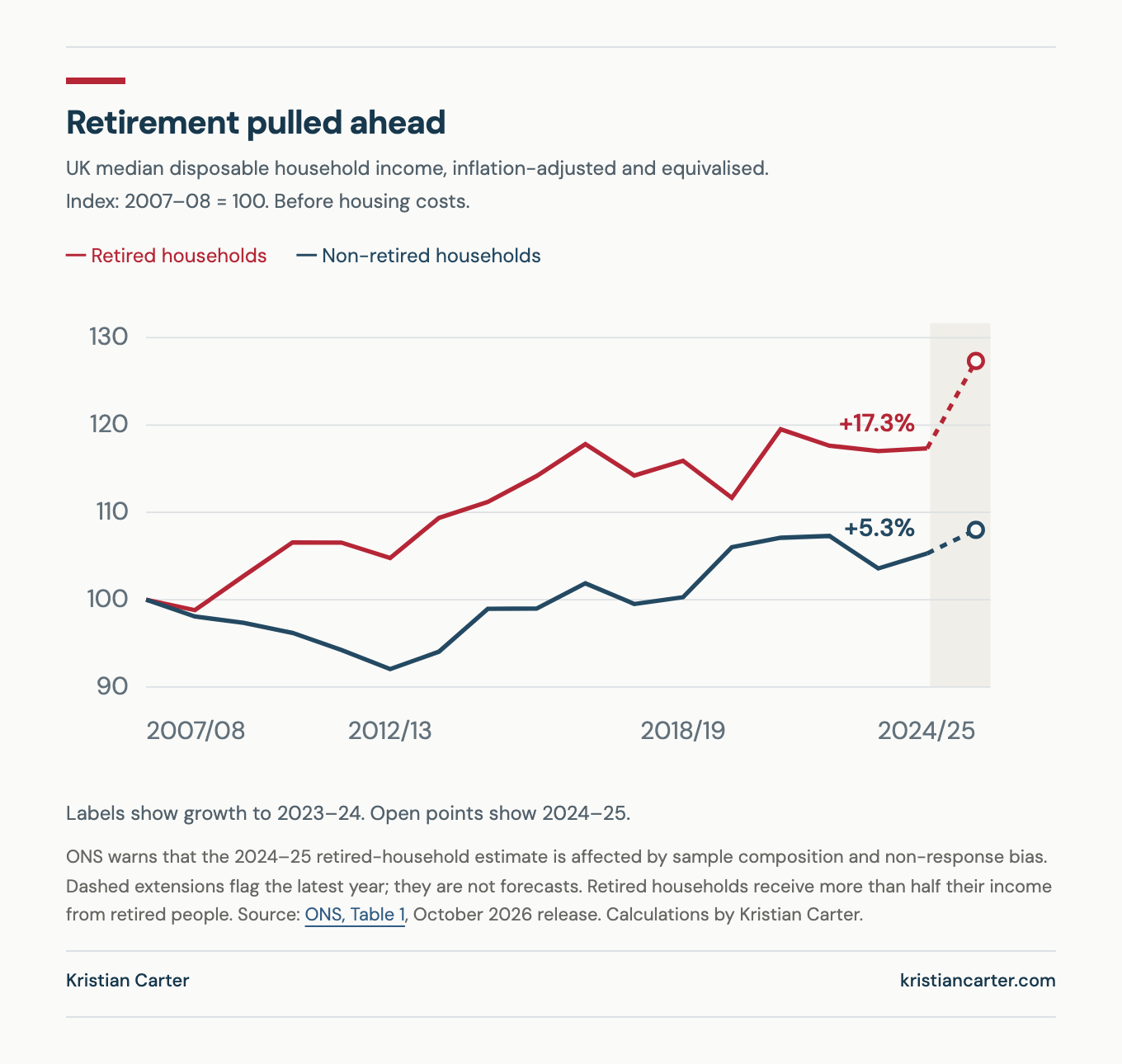
These figures compare household income after direct taxes, adjusted for inflation and household size, before housing costs. The groups are defined by retirement status and the source of household income, rather than a simple age cut-off. Retired households still had lower median incomes in 2023–24: about £30,700 against £39,800, expressed in 2024–25 prices. The finding is faster growth from a lower starting point, not universal pensioner affluence.
The latest estimates, for 2024–25, widen the gap in cumulative growth further. But ONS warns that the retired-household sample shifted towards richer homeowners, with weighting unable to remove the distortion fully. The chart marks that final observation separately. The preceding sixteen years provide ample evidence without treating a sampling problem as another triumph of pensioner prosperity.
Housing makes the comparison less comfortable for working-age households. DWP reports that more than three-quarters of pensioners own their homes outright, compared with a quarter of working-age adults. A household with no rent or mortgage can manage on less cash than one supporting a landlord or lender. An income comparison made before those payments necessarily misses part of the difference in what remains available to spend.
This improvement in retirement living standards was desirable. A country should be pleased when fewer people spend old age worrying about ordinary bills. Nor can the entire change be credited to the triple lock. Private pensions, employment within pensioner families and the changing composition of the retired population also contribute. The Institute for Fiscal Studies’ account of pensioner incomes identifies several such influences. People retiring today are not the same people, with the same financial histories, as those retiring twenty years ago.
What distinguishes the state pension is its political insurance. Under the current triple lock, its main rates rise by the highest of earnings growth, inflation or 2.5%. A worker has no equivalent claim on their employer. Their pay depends on productivity, bargaining power and whether the business can afford an increase. The pension’s formula selects the most favourable of three benchmarks; the wage earner must negotiate with reality.
The tax system then supplies a second difference. The full new state pension rose from £179.60 a week in 2021–22 to £241.30 in 2026–27, a cash increase of 34.4%. Over the same period, the standard personal allowance remained £12,570. Those are nominal amounts, not gains in purchasing power. Their interaction explains why the pension is approaching a threshold that inflation has made steadily less generous.
A rising pension, a frozen threshold
Full new state pension and standard personal allowance.
£ per year, cash terms. Pension = weekly rate × 52.
Download chart (PNG) · Data (CSV)
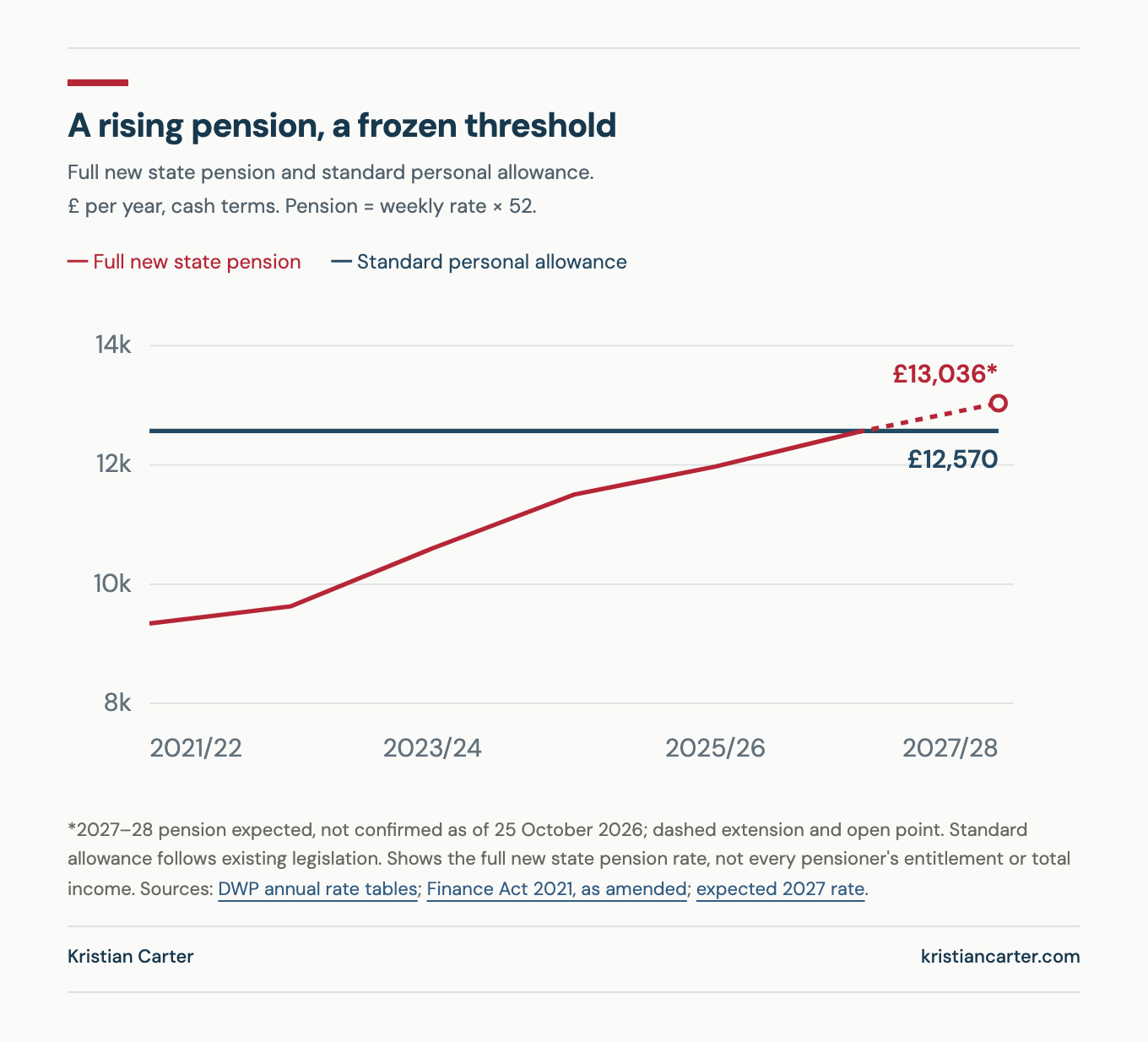
The Office for Budget Responsibility describes the mechanism as fiscal drag. When allowances stay fixed, nominal income growth brings more income into tax even if living standards barely improve. The apparent restraint of leaving tax rates alone conceals a steadily expanding claim on earnings. The ingenuity lies in making a tax increase arrive through the payslip as though it were an unfortunate side effect of a pay rise.
Better-off pensioners experience fiscal drag too. Swinford’s report says those with higher incomes, including private pensions, would continue to pay tax. That limits the proposed measure and makes its immediate beneficiaries a poor target for resentment. Someone living on the state pension is hardly an emblem of excess. The sharper question is why comparable financial need should receive different treatment according to whether its owner has reached retirement.
The government has acknowledged that the existing pension formula cannot simply be extrapolated indefinitely. Its published reform plans would adjust the triple lock from April 2030, retaining inflation and 2.5% protections while linking increases to maintaining or restoring the pension’s value relative to earnings. The intention is for pensions to track wages over time rather than repeatedly outpace them. That is a substantial qualification to the claim that pensioner protection is politically untouchable. It also leaves the immediate asymmetry between indexed pensions and frozen tax allowances intact.
This is more than a contest between age groups. Today’s workers are tomorrow’s pensioners, and they have an interest in a dependable retirement income. They also need sufficient earnings during working life to pay for housing, support children and build savings. A settlement that protects the eventual pension while allowing the route towards it to become less rewarding offers security at one end of a career and frustration along much of the rest.
The answer cannot be to manufacture equality by making poorer pensioners worse off. A defensible system would protect a minimum standard of living, explain how pensions should move with national earnings and justify tax relief by reference to need. It would also give working households a credible account of when growth in their pay will translate into growth in disposable income. Exempting one group from fiscal drag does little to explain why everyone else should continue to endure it.
The proposed concession may be modest. Its significance lies in the priority it reveals. When the pension approaches the tax threshold, the government looks for a way to move the threshold. When wages cross it, the Treasury counts the receipts. Britain need not apologise for improving retirement. It does need to explain why earning a living has become such a less convincing route to getting ahead.